
Use this free US Navy Body Fat Calculator to estimate your body fat percentage using the official Navy method. This circumference‑based body fat calculation uses height, neck, waist, and hip measurements to provide a reliable estimate of body composition without calipers or advanced equipment.
Unlike many complex tools, the Navy Tape Measure Method allows you to calculate body fat percentage online using simple body measurements you can take at home.
About the US Navy Body Fat Calculator
The Naval Health Research Center developed the US Navy body fat formula to provide a practical way to estimate body fat percentage in military personnel. The method was designed to be simple, repeatable, and usable in field conditions without expensive equipment.
The formula is based on the research of Hodgdon and Beckett, who developed specific logarithmic equations to estimate body density from circumference measurements. Once body density is calculated, the Siri equation is applied to convert density into body fat percentage.
This approach is known as the Navy method body fat calculation, or more simply, the circumference method body fat approach. Instead of measuring skinfold thickness or using electrical devices, it relies on:
- Height
- Neck circumference
- Waist (abdominal) circumference
- Hip measurement (for women)
Because it only requires a measuring tape, it is often referred to as a body fat measurement using the tape method.
The reason it is widely used, even outside the military, is that it provides a practical balance between convenience and reasonable accuracy for general body composition estimation.
How to Measure Body Parts Correctly (Navy Tape Measure Method)
Accurate body measurements are critical for reliable results. Even small errors in measurement can affect the final body fat percentage.
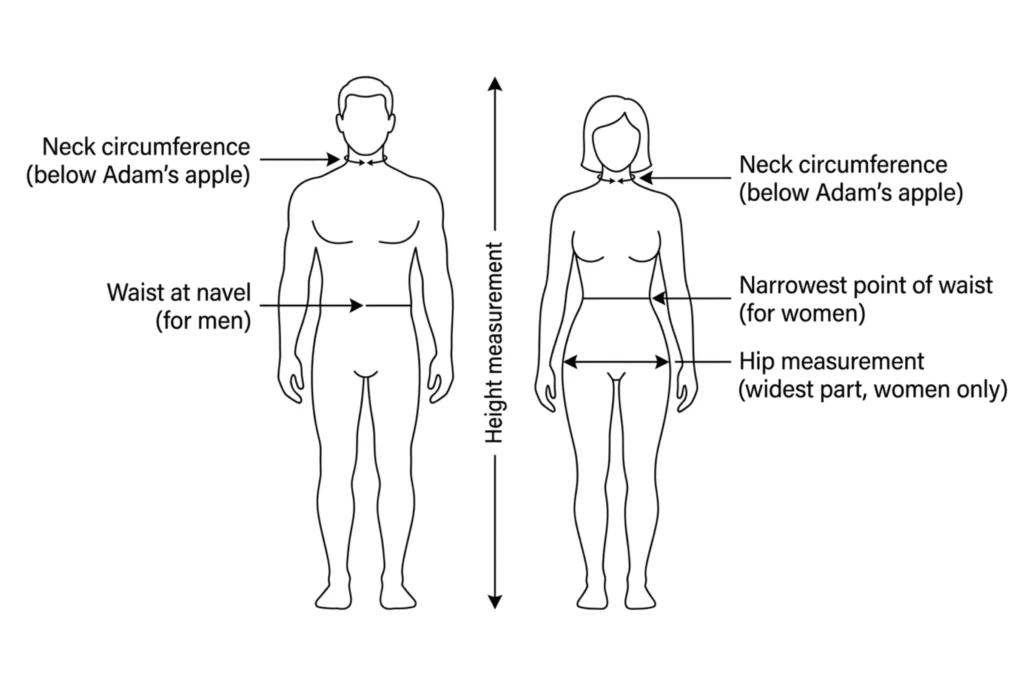
Measuring Neck Circumference
Measure the neck just below the laryngeal prominence (Adam’s apple).
Keep the tape horizontal and snug but not tight. The measurement should be taken while standing upright and looking straight ahead.
Neck circumference is an important variable in the Navy body fat percentage formula because it helps balance the waist measurement in the logarithmic equation.
Measuring Waist / Abdominal Circumference
For men, measure abdominal circumference at the level of the navel.
For women, measure at the narrowest point of the waist.
Keep the abdomen relaxed. Do not suck in your stomach. The tape should remain parallel to the floor.
Because waist size strongly influences body fat estimation, this measurement plays a major role in the body fat tape measurement method.
Measuring Hip Circumference (Women Only)
Women must measure hip circumference at the widest part of the hips.
This measurement is included in the female-specific Navy method body fat calculation to improve accuracy.
Height Measurement (Inches or CM)
Height can be entered in inches or centimeters, depending on the calculator settings. Stand straight against a wall without shoes for the most accurate measurement.
These body measurements for body fat estimation must be consistent each time you measure to ensure reliable tracking over time.
Body Fat Percentage Chart & Categories
Once calculated, your body fat percentage can be compared to a standard body fat percentage chart. These charts categorize results into general fitness levels.
Healthy Body Fat Range for Men
- Essential fat: 2–5%
- Athletic: 6–13%
- Fitness: 14–17%
- Average: 18–24%
- Obese: 25%+
Ideal Body Fat Percentage for Women
- Essential fat: 10–13%
- Athletic: 14–20%
- Fitness: 21–24%
- Average: 25–31%
- Obese: 32%+
Essential fat percentage represents the minimum fat required for basic physiological function. A healthy body fat range depends on age, gender, and activity level.
Understanding these body fat categories helps put your results into context beyond just a number.
How Accurate Is the Navy Body Fat Calculator?
A common question is:
How accurate is the Navy body fat method?
Compared to gold‑standard methods like a DEXA scan, the Navy method typically has a margin of error of about ±3–4%. While DEXA provides a more detailed body density and fat mass breakdown, it requires specialized equipment.
Compared to Bioelectrical Impedance Analysis (BIA), which uses electrical currents to estimate body composition, the Navy method can be more consistent when measurements are taken correctly.
However, accuracy depends on:
- Proper tape placement
- Consistent measurement technique
- Body shape variations
The advantages of the Navy method include convenience and accessibility. The limitations of the Navy body fat formula include reduced precision for individuals with unusual fat distribution patterns.
Overall, it is a practical tool for fitness tracking rather than a medical diagnostic device.
Importance of Body Fat Percentage in Fitness Tracking
Body fat percentage provides deeper insight than weight alone.
Understanding lean mass vs fat mass helps clarify body composition changes. For example, weight may stay the same while lean body mass increases and fat mass decreases.
This highlights the difference between BMI and body fat. BMI does not distinguish between muscle and fat, which can misclassify athletic individuals.
By using the Navy Body Fat Calculator as a fitness tracking tool, individuals can:
- Monitor fat reduction progress
- Evaluate lean body mass changes
- Adjust training or nutrition strategies
Body composition assessment is more meaningful than scale weight alone.
Understanding lean mass vs fat mass helps improve body composition tracking. You can estimate this using our Lean Body Mass Calculator.
Navy Body Fat Formula Explained (Technical Section)
The Navy method uses logarithmic equations to estimate body density.
For men:
Body Fat % = 86.010 × log10(abdominal circumference − neck circumference) − 70.041 × log10(height) + 36.76
For women:
Body Fat % = 163.205 × log10(waist + hip − neck) − 97.684 × log10(height) − 78.387
These equations were derived by Hodgdon and Beckett and validated by the Naval Health Research Center.
After estimating body density, the Siri equation is used to convert density into body fat percentage.
The formula differs between men and women because body fat distribution patterns differ physiologically.
This technical foundation strengthens the credibility of the Navy body fat percentage formula compared to simplified estimations.
Advantages and Limitations of the Navy Tape Measure Method
Advantages of the Navy Method
- Requires no equipment beyond a tape measure
- Free and accessible
- Quick and easy to perform
- Suitable for home use
Limitations of the Navy Body Fat Formula
- Depends on the precise measurement technique
- Less precise than DEXA scans
- May vary based on body type
- Not intended for medical diagnosis
Understanding both sides allows realistic expectations when using this method.
Related Body Composition Calculators
For a complete body composition analysis, you may also use:
- Lean Body Mass Calculator
- FFMI Calculator
- Waist-to-Hip Ratio Calculator
- Ideal Body Weight Calculator
- Fat Mass Calculator
- Sarcopenia Risk Calculator
These tools help expand beyond body fat percentage alone.
Frequently Asked Questions
It is reasonably accurate for general fitness tracking, typically within ±3–4% of more advanced methods.
A healthy range varies by gender and age, but generally falls within the fitness or average category ranges shown above.
Yes, because it estimates fat mass rather than just body weight relative to height.
Yes. The Navy tape measure method allows body fat calculation at home using simple measurements.
DEXA uses imaging technology to directly assess body density and composition, while the Navy method uses circumference measurements and mathematical formulas.