
Use this Lean Body Mass Calculator to estimate how much of your total body weight comes from lean tissue mass rather than adipose tissue. Lean body mass (LBM) represents everything in your body except stored fat, including muscle mass, bone density, vital organs, and body water content.
Lean Body Mass Calculator
Accurate fat-free mass estimation for health and fitness goals.
Enter your measurements to see your body composition breakdown.
Body Fat: 0%
What Is Lean Body Mass?
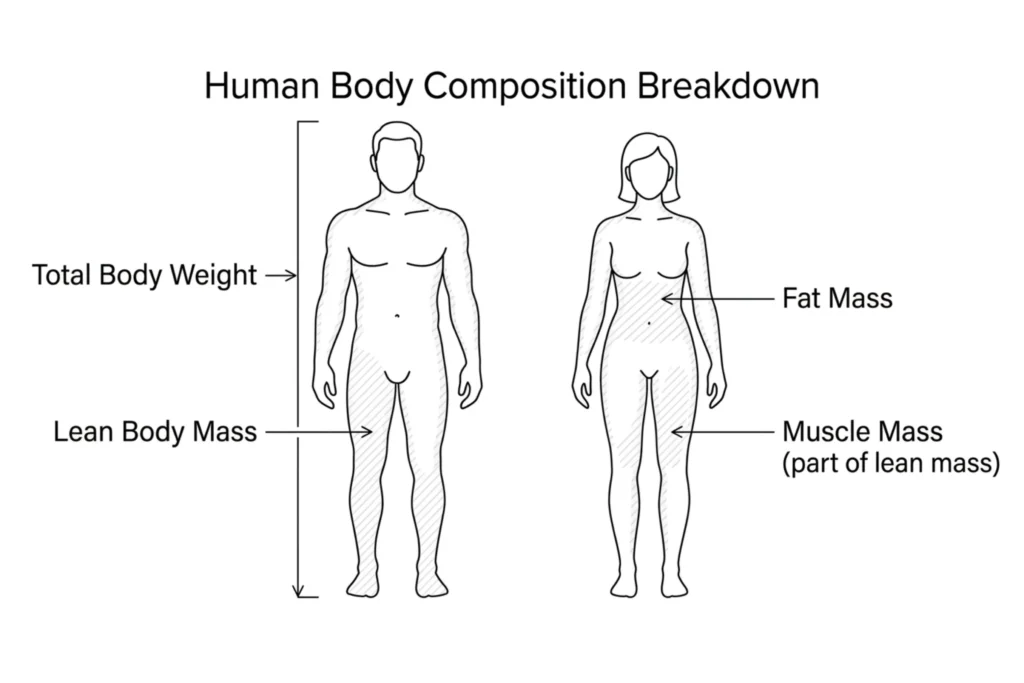
Lean body mass refers to the total body weight minus fat mass. In simple terms, it includes:
- Skeletal muscle mass
- Bone density
- Vital organs
- Body water content
When people ask what lean body mass is, they are usually trying to understand how much of their weight is functional tissue versus adipose tissue. Unlike body fat percentage, which focuses only on stored fat, lean body mass gives a broader view of body composition.
Lean mass vs fat mass is one of the fundamentals of body composition assessment. If your total body weight is 80 kg and your body fat percentage is 20%, then 16 kg is fat mass and 64 kg is lean body mass.
This distinction matters because lean mass plays a key role in metabolic rate, strength, and physiological performance.
Lean Body Mass vs. Fat Free Mass
The difference between lean body mass and fat-free mass is subtle but important.
The lean body mass vs. fat-free mass difference mainly comes down to essential fat. Lean body mass technically includes essential fat stored within organs and tissues, while fat-free mass excludes all fat entirely.
In most practical contexts, lean body mass and fat-free mass are used interchangeably. However, in clinical study environments and health standards assessments, fat-free mass is considered a stricter measurement.
Lean mass vs muscle mass is another common confusion. Muscle mass is part of lean mass, but lean mass also includes organs, connective tissue, and fluids. Lean tissue mass is a broader biological term that includes everything non-fat.
Understanding these definitions improves clarity when using an LBM calculator or fat-free mass calculator.
Lean Body Mass Formulas Explained
Lean body mass estimation is not directly measured in basic tools. Instead, equations use height and weight variables along with gender-specific constants to estimate LBM.
These formulas were developed from physiological research and body composition formula modeling.
Boer Formula (Most Common)
The Boer formula is widely used in lean body mass calculators for adults.
For men:
LBM = (0.407 × weight in kg) + (0.267 × height in cm) − 19.2
For women:
LBM = (0.252 × weight in kg) + (0.473 × height in cm) − 48.3
This lean body mass equation works well for general adult populations and is commonly implemented in an LBM calculator.
Example:
If a male weighs 70 kg and is 175 cm tall:
LBM ≈ (0.407 × 70) + (0.267 × 175) − 19.2
LBM ≈ 28.49 + 46.73 − 19.2 ≈ 56 kg
James Formula
The James formula adjusts lean body weight differently based on height and weight proportions. It may perform differently in obese vs athletic populations.
Hume Formula
The Hume formula also uses height in cm and weight in kg, but has slightly different constants, offering an alternative lean body mass estimation model.
Formula Comparison Breakdown
Boer vs James vs Hume formulas vary slightly in accuracy levels depending on body type.
- Boer: Good for general adults
- James: Can vary in obese populations
- Hume: Alternative model, similar output
None is perfect. All are estimation-based tools relying on total body weight and height.
How to Calculate Lean Body Mass in KG (Step-by-Step)
To calculate lean body mass manually:
- Measure height in cm (or convert height in feet to cm).
- Measure weight in kg (or convert weight in pounds using kg to lbs conversion).
- Apply the formula.
For example:
Weight = 80 kg
Height = 180 cm
Using the Boer formula for men:
LBM = (0.407 × 80) + (0.267 × 180) − 19.2
LBM ≈ 32.56 + 48.06 − 19.2 = 61.42 kg
Metric vs imperial units can both be used, but conversion must be consistent.
Lean Body Mass Formulas for Adults
Adult formulas assume stable physiological factors and typical body composition patterns. They rely on reference range data from clinical study populations.
Gender-specific constants account for differences in skeletal muscle mass and fat distribution between men and women.
Age also influences lean mass and metabolism, especially after middle age.
Lean Body Mass Formula for Children
The lean body mass formula for children is more complex. Children and adolescents experience growth-related changes in bone density, muscle mass, and body water content.
Adult equations may not apply accurately to pediatric populations. Specialized health standards and pediatric biological markers are required for a more precise assessment.
For general use, calculators should be considered informational only for children.
Lean Body Mass Chart by Height and Weight
A lean body mass chart provides estimated LBM ranges based on height and weight.
Example (Male Approximation):
| Height (cm) | Weight (kg) | Estimated LBM (kg) |
|---|---|---|
| 170 | 70 | 54–57 |
| 175 | 80 | 60–63 |
| 180 | 85 | 63–66 |
Why Lean Mass Matters for Metabolism
The relationship between lean mass and metabolism is critical.
Lean body mass directly affects Basal Metabolic Rate (BMR). Muscle tissue requires more energy than fat tissue. Therefore, higher lean mass increases calorie burn even at rest.
How lean body mass affects BMR:
- More lean mass → Higher BMR
- Higher BMR → Greater daily calorie needs
Lean mass and calorie requirements are closely linked. This is why lean mass influences TDEE calculator results and daily calorie needs planning. The healthy lean mass range depends on body type and activity level. Lean body mass for athletes is typically higher due to greater skeletal muscle mass.
Lean Mass vs Muscle Mass
Lean mass vs muscle mass difference:
- Muscle mass is part of lean mass.
- Lean mass includes organs, bones, and body water content.
Muscle mass calculator tools often isolate skeletal muscle mass, while lean body mass calculators estimate total non-fat tissue.
To estimate a height‑based reference weight, use our Ideal Body Weight Calculator.
Muscle Mass Calculator vs Lean Body Mass Calculator
A muscle mass calculator focuses only on muscle tissue.
A lean body mass calculator estimates broader lean tissue mass, including organs and fluids.
If your goal is metabolic tracking, lean mass estimation is more comprehensive.
Lean Mass vs Navy Body Fat
Lean mass and Navy body fat calculations measure two different things.
Lean body mass shows how much of your total body weight comes from muscle, bones, organs, and body water content.
The Navy body fat method estimates your body fat percentage using circumference measurements such as waist and neck. It focuses on how much fat is stored in the body, not how much lean tissue you have.
A Lean Body Mass Calculator helps you understand how much of your weight is non-fat tissue.
A Navy Body Fat Calculator helps you estimate the percentage of fat in your body.
If you want to track changes in muscle and metabolism, lean mass is more useful. If you want to monitor fat reduction, the Navy body fat method may be more relevant.
For a full body composition overview, you can use both tools together.
Try our Navy Body Fat Calculator to estimate your body fat percentage.
Limitations of Lean Body Mass Calculations
Lean body mass calculators are estimation tools.
Limitations include:
- Hydration affecting results
- Formula assumptions
- Obese vs athletic populations responding differently
- Not accounting for biological markers
They are useful for tracking progress but not for medical diagnosis.
Related Body Composition Calculators
To expand your body composition assessment:
- Navy Body Fat Calculator
- FFMI Calculator
- Fat Mass Calculator
- Ideal Body Weight Calculator
- BMR Calculator
- Skeletal Muscle Index (SMI) Calculator
- Relative Skeletal Muscle Index (RSMI) Calculator
- Grip Strength Calculator
Using multiple tools provides a more complete overview of your lean mass-to-fat mass ratio.
Frequently Asked Questions
No. Muscle mass is part of lean body mass, but lean mass also includes bones, organs, and body water.
It provides an estimate based on formulas. For higher accuracy, DEXA scans are recommended.
It depends on height, weight, gender, and activity level. Athletes typically have higher lean mass percentages.
Strength training and adequate protein intake support increases in skeletal muscle mass.
Yes. Higher lean mass increases Basal Metabolic Rate (BMR) and daily calorie requirements.