
Use this Waist‑to‑Hip Ratio Calculator to quickly check how your body fat distribution may affect your health. The waist-to-hip ratio (WHR) helps estimate how fat is stored around your waist compared to your hips. This matters because fat stored around the abdomen can increase health risks more than fat stored around the hips.
Waist-to-Hip Ratio Calculator
Identify health risks based on body fat distribution.
Enter your measurements to view your health risk analysis.
A high ratio indicates abdominal obesity, which is linked to cardiovascular disease and diabetes.
This tool allows you to calculate the waist-to-hip ratio using simple body measurements. It works with both metric and imperial units, so you can enter centimeters or inches easily.
How the Waist-to-Hip(WHR) calculator Formula Works
The waist-to-hip ratio formula is simple:
WHR = Waist circumference ÷ Hip circumference
To use the WHR calculator, you enter:
- Waist circumference
- Hip circumference
The calculator processes these input variables and gives you a result.
If your result is high, it may suggest more abdominal fat or central obesity. If it is lower, fat may be stored more around the hips.
What Is Waist‑to‑Hip Ratio?
Waist‑to‑hip ratio is a simple way to understand body fat distribution. It compares the size of your waist to the size of your hips.
It does not measure total body fat percentage. Instead, it shows where fat is stored in the body.
There are two common fat storage patterns:
- Apple-shaped body (Android obesity) – More fat around the waist and abdomen
- Pear-shaped body (Gynoid obesity) – More fat around the hips and thighs
Android fat distribution is often linked with higher cardiovascular risk and metabolic syndrome. Gynoid fat distribution is usually considered lower risk.
Health standards use WHR because abdominal obesity and visceral fat around organs are strong biological markers of health risk categories.
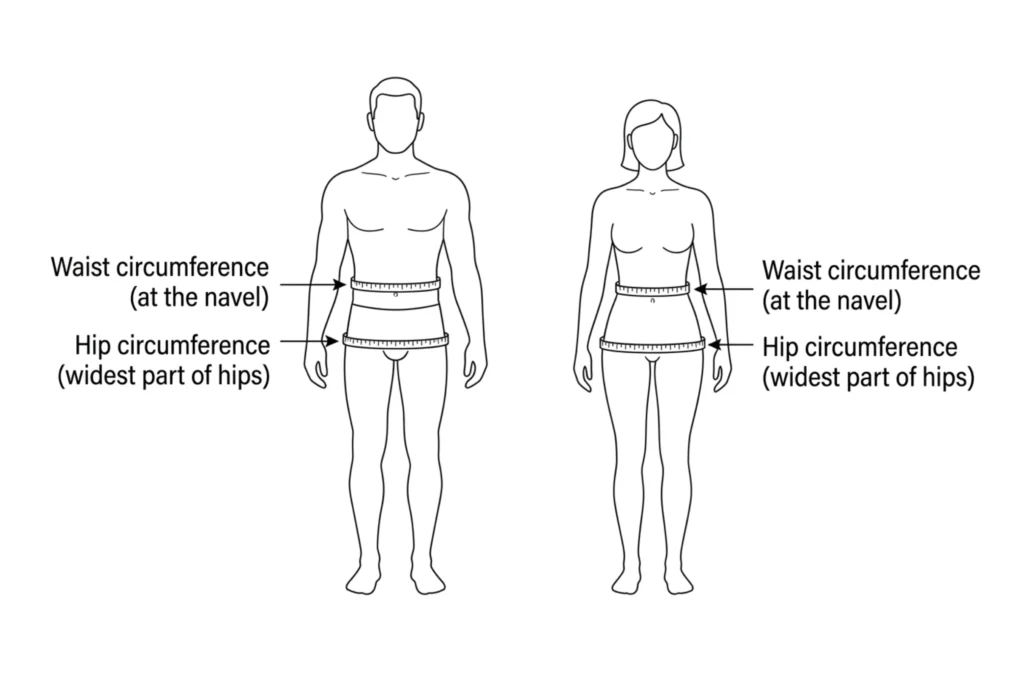
How to Measure Waist Correctly
Accurate tape measure placement is very important.
To measure waist circumference:
- Stand upright
- Place the tape around your waist at the navel
- Keep the tape horizontal
- Do not pull too tight
- Relax your abdomen
- Measure after normal exhalation
Some guides suggest measuring at the narrowest part of the torso, but for health standards and WHO waist-to-hip ratio guidelines, the waist measurement at the navel is commonly used.
Consistency is key. Always measure the same way when tracking progress.
How to Measure Hips Correctly
To measure hip circumference:
- Stand straight
- Wrap the tape around the widest part of the hips
- This usually includes the convexity of the buttocks
- Keep the tape level and flat
- Do not compress soft tissue
Using the iliac crest (the top of the hip bone) as a landmark can help you find the correct level.
Correct measurement improves the WHR calculator accuracy.
Waist‑to‑Hip Ratio Formula Explained
To calculate the waist-to-hip ratio:
Example:
Waist = 90 cm
Hips = 100 cm
WHR = 90 ÷ 100 = 0.90
The WHR calculator generator uses these input and output parameters automatically. It supports metric vs imperial conversion, so inches and centimeters both work.
WHR Chart for Men and Women
According to the WHO waist-to-hip ratio guidelines:
WHR Chart for Men
| WHR | Health Risk |
|---|---|
| < 0.90 | Low risk |
| 0.90 – 0.99 | Moderate risk |
| ≥ 1.00 | High risk |
WHR Chart for Women
| WHR | Health Risk |
|---|---|
| < 0.80 | Low risk |
| 0.80 – 0.84 | Moderate risk |
| ≥ 0.85 | High risk |
A healthy waist-to-hip ratio falls within the lower reference range.
Waist‑to‑Hip Ratio Chart by Age
For men over 40, fat storage patterns often shift toward central obesity. This can increase the risk of waist circumference even if total body weight stays similar.
A waist-to-hip ratio chart by age helps understand these changes better.
Health Risk Interpretation of WHR
A high waist-to-hip ratio may indicate:
- Abdominal obesity
- Increased visceral fat
- Central obesity
- Higher cardiovascular risk
- Increased risk of heart disease
- Higher obesity risk
WHR is used as one of several biological markers in body composition assessment.
WHR vs BMI (Comparison)
The difference between WHR and BMI is important.
Body Mass Index (BMI) measures weight relative to height. It does not show fat storage patterns.
BMI limitations include:
- Cannot separate muscle mass from fat mass
- Does not show abdominal fat
- May misclassify athletes
WHR vs BMI accuracy depends on the goal. If fat distribution is the concern, WHR may provide more useful information.
If you want to measure total body fat percentage instead of fat distribution, try our Navy Body Fat Calculator.
You can also compare your weight against a height‑based standard using our Ideal Body Weight Calculator.
WHR vs Waist‑to‑Height Ratio
WHR vs waist‑to‑height ratio (WHtR) is another comparison.
WHtR measures waist compared to height. Some research suggests WHtR may predict health risks slightly better than BMI.
Both are alternative body composition methods.
WHR and Body Fat Percentage Relationship
WHR vs body fat percentage comparison shows that:
- Body fat percentage measures total fat
- WHR measures fat distribution
A person may have a normal body fat percentage but a high waist-to-hip ratio if fat is concentrated in the abdomen.
The WHR and body fat percentage relationship helps understand both the quantity and the location of fat.
WHR vs Lean Body Mass
Lean body mass includes muscle mass, bone density, organs, and body water content.
WHR does not measure lean mass.
WHR vs lean body mass difference shows that one measures fat location, while the other measures non-fat tissue.
To understand how much of your total body weight comes from muscle and lean tissue, use our Lean Body Mass Calculator.
WHR vs FFMI
FFMI measures muscle mass index relative to height.
WHR measures fat distribution.
They serve different purposes in body composition analysis.
WHR and Skeletal Muscle Mass Distribution
Athletes may have wider hips due to muscle mass, especially in the gluteal region.
Healthy WHR for athletes may look different from that of sedentary individuals because skeletal muscle mass changes body proportions.
WHR and Metabolic Rate
The WHR and BMR relationship is indirect.
Higher central fat is linked with metabolic syndrome and insulin resistance. The relationship between lean mass and metabolism is stronger because muscle tissue increases calorie burn.
WHR and metabolic rate are connected through fat storage patterns and abdominal fat.
Clinical Accuracy Discussion
The WHR is simple and practical, but it is not perfect.
Compared to DEXA scans, which measure body fat distribution precisely, WHR is less detailed.
Compared to BIA devices, WHR is less affected by hydration.
WHR may vary in obese vs athletic populations.
It is best used as a screening tool, not a diagnostic tool.
Limitations of Waist‑to‑Hip Ratio
- Does not measure total body fat
- Does not account for muscle mass
- Can vary by genetics
- Not a medical diagnosis
It should be combined with other health standards and biological markers for a better understanding.
Related Body Composition Calculators
Frequently Asked Questions
A healthy waist-to-hip ratio is below 0.90 for men and below 0.80 for women.
WHR shows fat distribution. BMI shows weight relative to height. Both measure different things.
No. It measures fat distribution, not total body fat.
It is useful for screening health risk, but not as precise as clinical testing.
Sometimes, due to muscle distribution, but this must be interpreted carefully.
High abdominal fat is linked with metabolic syndrome and increased cardiovascular risk.
Yes. Reference ranges differ based on gender.
Higher WHR often indicates more visceral fat stored around abdominal organs.