
Use this Ideal Body Weight Calculator to estimate your healthy weight range based on established formulas. This tool uses height‑based estimation methods, including the Devine, Robinson, Miller, and Hamwi formulas.
The IBW calculator gives a reference weight. It does not give a medical diagnosis. It helps you understand where your body weight stands compared to standard anthropometric calculation models.
Above the Calculator
Ideal body weight (IBW) is a height‑based formula used to estimate a healthy weight reference range. It is not your actual body weight. It is a comparison number.
You can enter height in cm or height in feet and inches. The tool supports metric vs imperial conversion. The result shows your estimated reference weight in kg and pounds.
This is a weight estimation formula, not a diagnosis tool.
What Is Ideal Body Weight (IBW)?
Ideal body weight means a reference weight calculated from height using gender‑specific constants. It is based on population data and clinical guidelines.
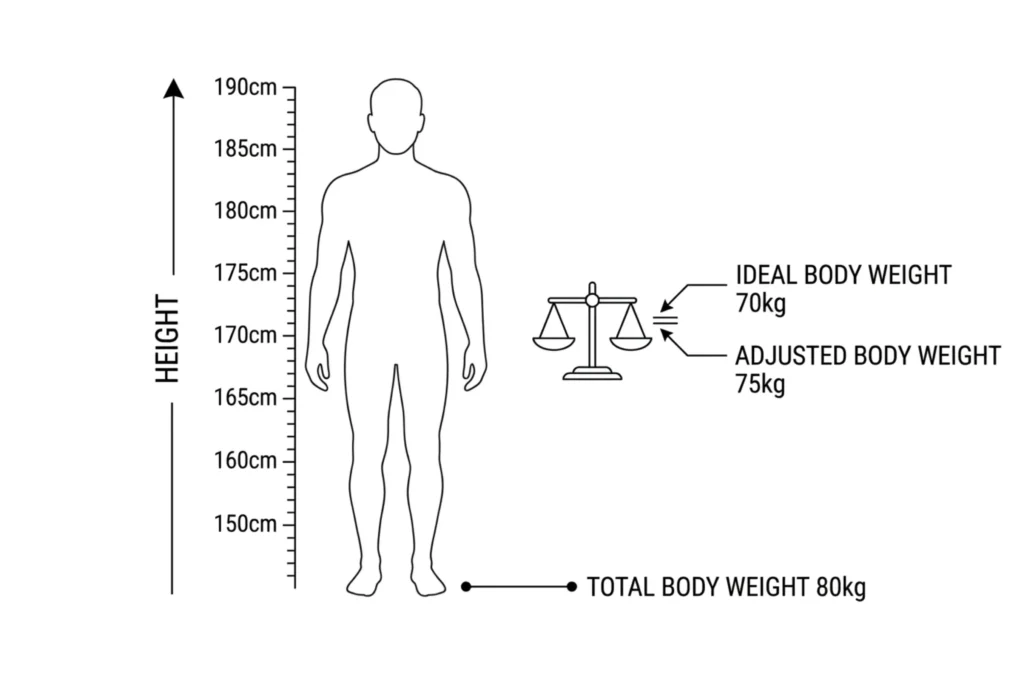
IBW is different from total body weight. Total body weight includes fat mass, muscle, bone, and body water. IBW is only a calculated reference weight.
IBW vs actual body weight shows how close your weight is to a height‑based standard. It does not measure body fat percentage.
IBW vs lean body mass is also different. Lean body mass includes muscle and organs. IBW is just a height‑based number.
IBW is part of body mass considerations in both fitness and medical positioning. It is commonly used in health standards as a reference range.
Why Use Ideal Body Weight?
People use the ideal weight by height for:
- Fitness planning
- Weight goal setting
- Healthy weight chart comparison
- Reference weight tracking
It helps compare your weight to a height-weight reference chart.
However, IBW is not a personalized medical prescription. It does not account for muscle mass, bone density, or body composition formula differences.
Athletes and muscular individuals may exceed IBW without being unhealthy.
Ideal Body Weight Formula Explained
What is the formula for calculating ideal body weight?
IBW uses height‑based formulas with gender‑specific constants. These formulas were developed for clinical reference and drug dosing calculations in the past.
Different formulas exist because body proportions vary across populations.
Devine Formula
The Divine formula was introduced in 1974. It is the most commonly used IBW formula.
For men:
50 kg + 2.3 kg for each inch over 5 feet
For women:
45.5 kg + 2.3 kg for each inch over 5 feet
This formula is widely used as a reference weight in clinical guidelines.
Is the Divine formula accurate?
It provides a reasonable reference range but does not account for body composition differences.
Robinson Formula
The Robinson formula adjusts the kg per cm multiplier slightly. It may produce slightly lower values than Devine.
It still uses height‑based formula logic.
Miller Formula
The Miller formula slightly changes the weight-per-inch constant. It is another anthropometric calculation approach.
Hamwi Formula
The Hamwi formula was one of the earliest IBW equations. It also uses inches over 5 feet in structure.
All formulas estimate ideal body weight based on height in feet and inches or height in cm.
Formula Comparison Breakdown
Devine vs Robinson vs Miller vs Hamwi shows small differences in output.
None of these formulas is an exact science. They are population‑based models.
Differences occur because:
- Body proportions vary
- Obese vs athletic populations differ
- Physiological factors vary
All formulas produce a reference range, not a fixed health requirement.
Example Calculation (Step‑by‑Step)
Let’s calculate ideal body weight manually.
Example:
Height = 5 feet 10 inches
Using the Divine formula (male):
50 kg + (2.3 × 10 inches)
= 50 + 23
= 73 kg
In pounds:
73 kg × 2.20462 = 161 lbs
The IBW calculator performs this automatically using input variables such as height in cm or height in feet.
Adjusted Body Weight (AdjBW)
Adjusted body weight is used when actual body weight is much higher than IBW.
The adjusted body weight formula helps estimate a more realistic dosing weight or reference weight.
Basic concept (non‑clinical):
AdjBW = IBW + 0.4 × (Total body weight − IBW)
This is called obesity adjustment in some contexts.
When to Use Adjusted Body Weight
Adjusted body weight calculation is often used when:
- Total body weight is significantly above IBW
- Body mass considerations affect medication dosing
- Clinical guidelines require obesity adjustments
It should not be used casually without understanding the context.
Clinical Context of Ideal Body Weight
IBW has historically been used in:
- Medication dosing
- Pharmacokinetics
- Renal dosing
- Drug dosing calculations
It serves as a reference weight in medical positioning.
However, modern clinical practice often combines IBW with other measurements such as BMI and body composition assessment.
This calculator provides a simplified version for informational purposes.
Ideal Body Weight vs BMI
The IBW vs BMI comparison is common.
BMI vs IBW accuracy differs:
- BMI measures weight relative to height squared.
- IBW estimates reference weight based only on height.
BMI limitations include not accounting for muscle mass. IBW limitations include not accounting for body fat percentage.
Both are alternative body composition methods.
Ideal Body Weight vs Lean Body Mass
Lean body mass includes muscle, organs, and body water.
IBW is a height‑based target reference weight.
Lean body weight difference matters because IBW does not reflect muscle mass.
If you want body composition detail, use a Lean Body Mass Calculator.
Limitations of Ideal Body Weight
IBW does not:
- Account for muscle mass
- Measure body fat percentage
- Reflect bone density
- Adjust for obese vs athletic populations
It is based on population averages and anthropometric calculation models.
It is not a diagnostic tool.
Is Ideal Body Weight Still Used Today?
Yes, IBW is still used today as a reference weight.
It remains common in calculators and clinical guidelines.
However, it is often combined with BMI, body fat percentage, and other health standards.
How Do I Find My Ideal Weight Calculator?
To calculate ideal body weight:
- Enter height in cm or feet and inches.
- Select gender.
- Review the result in kg or pounds.
Use it along with a healthy weight reference range and other body composition tools.
Related Body Composition Calculators
For deeper analysis:
- Navy Body Fat Calculator
- Lean Body Mass Calculator
- FFMI Calculator
- Waist‑to‑Hip Ratio Calculator
- BMR Calculator
- Grip Strength Calculator
- Sarcopenia Risk Calculator
Combining tools gives a better overview of body composition.
Frequently Asked Questions
The most common is the Divine formula using inches over 5 feet and gender‑specific constants.
It provides a useful reference range but does not account for body composition.
Yes, as a reference weight in both clinical and fitness settings.
Use a height‑based formula such as Devine, and convert to kg or pounds.
Both measure different things. Neither replaces body composition analysis.
Athletes may exceed IBW due to higher muscle mass.