
The FFMI calculator helps you measure how much lean mass you have relative to your height. FFMI stands for fat-free mass index. It is used to assess muscle development beyond BMI.
FFMI Calculator
Calculate your Fat-Free Mass Index and track your genetic muscular potential.
Use this FFMI calculator to calculate fat free mass index based on your lean body mass and height normalization. FFMI helps assess muscle development beyond BMI by accounting for body composition.
Enter your weight, height, and body fat to see your muscularity index.
| Category | Range |
|---|---|
| Below Average | 16 – 17 |
| Average | 18 – 19 |
| Above Average | 20 – 21 |
| Excellent | 22 – 23 |
| Superior | 24 – 25 |
| Suspicious / Enhanced | 26+ |
Normalized FFMI: Adjusted for a standard height of 1.8m (approx. 5’11”) to allow fairer comparisons between lifters of different heights.
Unlike body weight alone, FFMI looks at lean body mass and adjusts it for height. This makes it a more accurate body composition metric for athletes and natural lifters.
Results are estimates and are for informational use only.
Above the Calculator
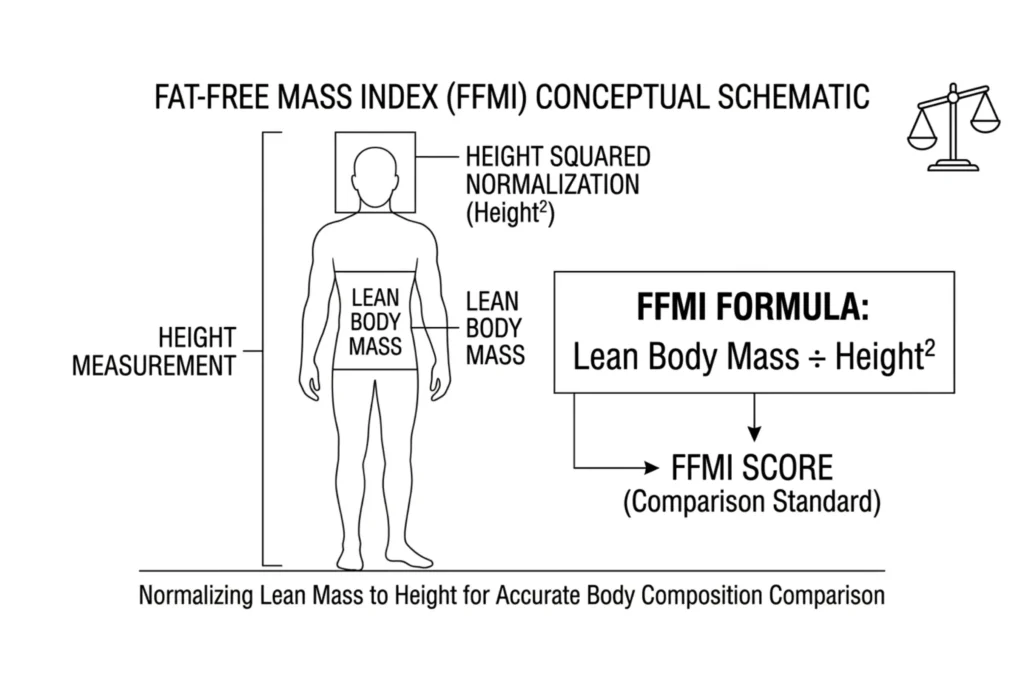
The FFMI formula is simple:
FFMI = Lean Body Mass (kg) ÷ Height² (m²)
This means you divide your lean body mass by your height in meters squared. The result is expressed in kg/m².
The calculator supports metric vs imperial conversion. You can enter weight in kg or pounds. Height can be converted internally to meters.
The output tells you how muscular you are relative to your height.
What Is FFMI (Fat‑Free Mass Index)?
FFMI's meaning refers to a height‑adjusted muscle mass index. It is also called the fat-free mass index.
It measures fat-free mass relative to height. Fat‑free mass includes muscle, bone, organs, and body water. It excludes body fat percentage.
FFMI explained simply:
- BMI measures weight relative to height.
- FFMI measures lean mass relative to height.
Because it removes fat mass from the equation, it is often considered better for assessing muscularity.
This is why many natural bodybuilding discussions use FFMI for natural lifters.
FFMI Formula Explained
The FFMI formula depends on two things:
- Lean body mass
- Height normalization
Lean body mass divided by height squared removes height bias. Taller individuals naturally carry more mass. The height adjustment formula ensures a fair comparison.
Some advanced versions include:
- Adjusted FFMI
- Normalized FFMI
These apply height normalization adjustments to compare individuals at a reference height.
How to Calculate FFMI (Step‑by‑Step)
To calculate FFMI manually:
- Calculate lean body mass.
- Convert height to meters.
- Apply the FFMI equation.
Example:
Weight = 80 kg
Body fat percentage = 15%
Lean body mass = 80 × (1 − 0.15) = 68 kg
Height = 1.75 meters
FFMI = 68 ÷ (1.75 × 1.75)
FFMI ≈ 22.2 kg/m²
FFMI in kg is always expressed as kg/m².
FFMI in pounds requires converting the weight first before calculation.
This is how to calculate FFMI accurately.
FFMI Chart and Classification
An FFMI chart helps interpret your score.
Typical FFMI classification:
- Below 18 → Beginner FFMI
- 18–20 → Average FFMI
- 20–22 → Above average
- 22–25 → Excellent
- 25+ → Elite FFMI
The healthy FFMI range depends on gender and body fat percentage.
An FFMI bodybuilding chart is often used in fitness communities.
FFMI Normal Range in KG
FFMI normal range in kg depends on lean body mass and height.
A healthy FFMI range for men often falls between 18 and 22.
For women, values are typically lower due to natural body composition differences.
Average FFMI male scores vary based on training history.
Elite FFMI values above 25 are uncommon without enhancement.
FFMI and Lean Mass Relationship
FFMI directly depends on lean body mass.
Lean mass vs skeletal muscle mass difference matters. Skeletal muscle is part of lean body mass. Lean mass also includes organs and body water.
Lean body mass index and FFMI are closely connected. If lean mass increases while height stays constant, FFMI increases.
You can estimate lean mass using a Lean Body Mass Calculator.
FFMI and Navy Body Fat Comparison
The Navy body fat calculator estimates body fat percentage using circumference measurements.
FFMI measures lean mass relative to height.
FFMI vs Navy body fat comparison shows:
- Navy measures fat percentage.
- FFMI measures muscle potential.
Both tools provide different body composition insights.
FFMI vs BMI (Accuracy Comparison)
FFMI vs BMI accuracy comparison shows key differences.
BMI ignores muscle mass.
FFMI accounts for lean body mass.
Athletes are often misclassified as overweight using BMI. FFMI avoids this issue.
Is FFMI better than BMI?
For muscular individuals, yes.
FFMI vs Skeletal Muscle Mass
The FFMI vs skeletal muscle mass difference is important.
Skeletal muscle mass measures only muscle tissue.
FFMI measures total fat‑free mass.
FFMI is not purely muscle mass. It includes bone and organ mass.
FFMI for Athletes vs Obese Populations
FFMI for athletes tends to be higher because athletes have more muscle mass.
Obese vs athletic populations may have similar total body weight but very different FFMI scores.
Interpretation depends on body fat percentage and training level.
FFMI and Metabolic Rate
Lean mass drives Basal Metabolic Rate (BMR).
Higher FFMI often correlates with higher BMR. Muscle tissue requires more energy than fat tissue.
The lean mass and metabolism relationship explains why strength training increases calorie burn.
FFMI and metabolic rate are connected through lean mass.
Natural FFMI Limit (High‑Traffic Section)
The natural FFMI limit is a popular topic.
The Kouri study (natural bodybuilder research) found that FFMI above 25 is rare among natural lifters.
FFMI natural limit calculator discussions often center around:
- FFMI over 25
- Natural bodybuilding FFMI
- Natty limit FFMI
- Steroid users FFMI
Many believe an FFMI above 25 suggests enhanced performance. However, genetic muscle potential varies.
Genetic muscle ceiling differs among individuals.
Limitations of FFMI
FFMI depends on accurate body fat percentage.
If the body fat estimate is wrong, the lean mass estimate will also be wrong.
Height measurement errors also affect results.
FFMI is not a diagnostic medical tool.
It is a body composition metric for estimation only.
Related Body Composition Calculators
To understand your full body composition, use:
- Lean Body Mass Calculator
- Navy Body Fat Calculator
- Skinfold Body Fat Calculator
- Waist‑to‑Hip Ratio Calculator
- Ideal Body Weight Calculator
These tools work together.
Frequently Asked Questions
For men, 18–22 is average. Above 25 is rare naturally.
Yes, for muscular individuals.
It may suggest unusually high lean mass, but it is not proof.
The Kouri study suggests around 25 for natural lifters.
It depends on accurate lean body mass estimation.
No. It includes all fat‑free mass, not only muscle.